
Wholesale prices-based inflation rate rose to a ten-month high of 5.02 per cent for the week ended February 23, as food and some manufactured products turned costly. Inflation rate for the previous week was at 4.89 per cent and was last above five per cent on May 19, 2007 (5.06 per cent).

There was acceleration in prices of fuel and power (11.69 per cent) and manufactured products (2.55 per cent).
Inflation rose to 5.32 per cent for the week ended December 9, from 5.16 per cent in the previous week mainly due to increase in prices of some food articles including vegetables.

The wholesale price-based inflation surged to more than a decade high of 14.23 per cent in November, mainly due to hardening of prices of mineral oils, basic metals, crude petroleum and natural gas. WPI inflation has remained in double digits for eight consecutive months beginning April. Inflation in October this year was at 12.54 per cent, while in November 2020 it was at 2.29 per cent. "The high rate of inflation in November 2021, is primarily due to rise in prices of mineral oils, basic metals, crude petroleum & natural gas, chemicals and chemical products, food products etc as compared to the corresponding month of the previous year," the commerce and industry ministry said in a statement on Tuesday.
Inflation fell to 4.06 per cent for the week ended March 18 as against 4.28 per cent in the preceding week, mainly due to cheaper food articles including vegetables and non-food items.

Mahindra & Mahindra was the top laggard in the Sensex pack, sliding 2.05 per cent, followed by Bajaj Finance, Tata Steel, SBI, Asian Paints, Kotak Mahindra Bank and Titan. However, IT majors HCL Technologies and TCS defied the trend and gained 1.02 per cent and 0.47 per cent, respectively. FMCG firm Hindustan Unilever rose 0.32 per cent.
An appropriate policy response always warrants a correct diagnosis of the problem. That is why the recent trend in inflation and its causes, and the inflation outlook take on exceptional importance ahead of the RBI's policy review on January 25.

The rapid deceleration in prices has ignited a debate in New Delhi whether Asia's third-largest economy is heading towards deflation.
Inflation declined to 5.16 per cent for the week ended December 2 from 5.30 per cent in the previous week mainly due to a fall in the prices of fuel and food items.
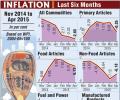
The deflationary trend has bolstered the case for a rate cut by RBI.
Wholesale price rise slowed down to 3.51 per cent for the week ended April 1 even though essential items like vegetables; industrial fuels and some manufactured products became costlier.
The good news on inflation continues as the wholesale price index fell for the tenth week in a row to an almost 11-month low of 5.24 per cent for the week ended January 3, prompting the Finance Ministry to project that it would go down to 3-4 per cent by March 31.

In November, wholesale prices, India's main inflation measure, rose 7.52 percent, their fastest pace in 14 months.
WPI-based inflation falls to 5-month low of 6.16%.
The government's statistical system is being overhauled with painful slowness. The base years for the indices are too far back in time, the weights for different sub-sets are out of date, the methods of data collection are defective, and the statistical methods used simplistic.

With the advancement of the base year and probably a revision of commodities in the index and their weights, it is expected that the index would provide a better picture of the current scenario of prices. The finance minister said information on weekly prices of manufactured products is highly meagre.
Wholesale inflation rate at five-month high in May; rupee breaches 60-a-$ mark, slides to lowest since May 5; Iraq crisis threatens to push global crude oil prices.
The Value Added Tax system has no adverse impact on consumer prices, and revenue earnings under the new regime have shot up by 15.3 per cent during the first quarter of the current fiscal, Finance Minister P Chidambaram told the Rajya Sabha on Tuesda

Costlier food items, including vegetables, pushed the October wholesale inflation to 7 per cent, the highest in the current financial year.

The Interim Budget for 2024-25 (FY25) to be presented on February 1 is likely to assume 10-10.5 per cent nominal gross domestic product (GDP) growth against 8.9 per cent estimated for FY24 by the National Statistical Office (NSO). "We were waiting for the First Advance Estimates GDP numbers for FY24. "We will finalise the nominal GDP growth assumption for FY25 Interim Budget in a couple of days.

In December, the index fell a provisional 0.73 per cent.
India's year-on-year inflation rate as measured by the consumer price index rose to 3.43 per cent in January from 3.2 in December, a government statement said on Wednesday.
Inflation based on the wholesale price index rose to 4.24% during the week ended October 1 from 3.97 per cent a week ago

The rise in May Wholesale Price Index based inflation has been mainly on account of 31.44 per cent increase in prices of potato, 19.40 per cent in fruits and 12.75 per cent in rice.
Food articles inflation dips to 8.14% from 9.50% last month.


The Wholesale Price Index-based inflation was (-)4.54% in Sep.

In the coming weeks prices are expected to further cool down as new crop from Karnataka has started coming into the market.

RBI in its policy review last month kept interest rates unchanged and said it sees an upside risk to inflation.

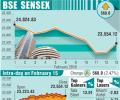
Benchmark indices Sensex and Nifty gave up early gains to close lower for a fourth straight session on Thursday due to selling in IT and banking shares amid weak global equities. The 30-share BSE benchmark settled 98 points or 0.18 per cent lower at 53,416.15. During the day, it hit a high of 53,861.28 and a low of 53,163.77. The broader NSE Nifty also pared initial gains and ended 28 points or 0.18 per cent down to settle at 15,938.65.

Hardening prices of manufactured items during the month may refrain the Reserve Bank of India from cutting rates in its policy review on February 8.

Former finance minister P Chidambaram on Friday rejected Finance Minister Arun Jaitley's contention in Lok Sabha that UPA government left behind double digit inflation.
However, prices of most agricultural items, barring potatoes, onions and wheat, continued to rise.

Prices of the kitchen staple in Azadpur mandi, Asia's largest wholesale market, were ruling at Rs 60 per kg today as supplies were below normal.

'The nominal GDP growth assumption for FY25 may be revised upwards on higher growth expectations.'

All the BSE sectoral indices closed in the green. BSE Realty, Auto, Capital Goods and Industrials were lead gainers, jumping up to 5 per cent. IndusInd Bank was the lead gainer among Sensex shares, surging by 6.84 per cent. Tata Motors rallied 4.50 per cent. Larsen & Toubro, Axis Bank, Adani Ports, HDFC Bank, ICICI Bank and HCL Tech were also among the gainers. ITC and Hindustan Unilever were the only laggards.

The Reserve Bank of India's rate-setting panel on Wednesday began its three-day deliberations on the next bi-monthly monetary policy amid expectations of at least a 35-basis-point hike in the interest rate to check high inflation. If raised, it will be the third consecutive hike in the repo rate -- the short-term rate at which the RBI lends money to banks. The central bank has already announced to gradually withdraw its accommodative monetary policy stance.
Experts say given the annual inflation, the increase might not be substantial for the industry, which has to deal with rising cost of manufacturing, raw material as well as packaging and logistics.

The government on Saturday imposed a 40 per cent duty on the export of onions to increase domestic availability amid signs of increasing prices. The export duty, which is the first time ever on onion, has been imposed as the retail sale price of the kitchen staple, according to government data, touched Rs 37/kg on Saturday in Delhi. The finance ministry through a Customs notification imposed a 40 per cent export duty on onions till December 31, 2023.
